

MCD-Level-2 Actual Questions Answers Pass With Real MCD-Level-2 Exam Dumps
MCD-Level-2 Dumps Prepare Your Exam With 62 Questions
NEW QUESTION # 20
In a Mule project, Flow-1 contains a flow-ref to Flow-2 depends on data from Flow-1 to execute successfully.
Which action ensures the test suites and test cases written for Flow-1 and Flow-2 will execute successfully?
- A. Chain together the test suites and test cases for Flow-1 and Flow-2
- B. Use ''Before Test Case'' To collect data from Flow-1 test cases before running Flow-2 test cases
- C. Use ''Set Event to pass the input that is needed, and keep the test cases for Flow-1 and Flow-2 independent
- D. Use 'After Test Case' to produce the data needed from Flow-1 test cases to pass to Flow-2 test cases
Answer: C
Explanation:
Explanation
To ensure the test suites and test cases written for Flow-1 and Flow-2 will execute successfully, the developer should use a Set Event processor to pass the input that is needed by Flow-2, and keep the test cases for Flow-1 and Flow-2 independent. This way, the developer can isolate the testing of each flow and avoid coupling them together. References: https://docs.mulesoft.com/munit/2.3/munit-test-flow
NEW QUESTION # 21
A Mule application deployed to a standardalone Mule runtime uses VM queues to publish messages to be consumed asynchronously by another flow.
In the case of a system failure, what will happen to in-flight messages in the VM queues that have been consumed?
- A. For transient queues, the message will be processed after the system comes online
- B. For any type of queue, the message will be lost
- C. For nay type of queue, the message will be processed after the system comes online
- D. For persistent queues, the message will be processed after the system comes online
Answer: D
Explanation:
Explanation
In case of a system failure, in-flight messages in persistent VM queues that have been consumed will be processed after the system comes online. This is because persistent VM queues store messages on disk and guarantee delivery even if there is a system crash or restart. Therefore, any in-flight messages that have been consumed but not processed will be recovered from disk and processed when the system is back online.
References: https://docs.mulesoft.com/mule-runtime/4.3/vm-connector#persistent-queues
NEW QUESTION # 22
A Mule application need to invoice an API hosted by an external system to initiate a process. The external API takes anywhere between one minute and 24 hours to compute its process.
Which implementation should be used to get response data from the external API after it completes processing?
- A. Use an HTTP Connector inside Async scope to invoice the API and wait for a response
- B. Expose an HTTP callback API in Mule and register it with the external system
- C. Use an HTTP Connector to invoke the API and wait for a response
- D. Use a Scheduler to check for a response every minute
Answer: B
Explanation:
To get response data from the external API after it completes processing, the developer should expose an HTTP callback API in Mule and register it with the external system. This way, the external API can invoke the callback API with the response data when it is ready, instead of making the Mule application wait for a long time or poll for a response repeatedly.
References:https://docs.mulesoft.com/mule-runtime/4.3/http-listener-ref#callback
NEW QUESTION # 23
A healthcare portal needs to validate the token that it sends to a Mule API. The developer plans to implement a custom policy using the HTTP Policy Transform Extension to match the token received in the header from the heathcare portal.
Which files does the developer need to create in order to package the custom policy?
- A. XML template file, YAML configuration file
- B. JSON properties file, YAML configuration file
- C. JSON properties file, XML template file
- D. Deployable ZIP file, YAML configuration file
Answer: A
Explanation:
Explanation
To package a custom policy using the HTTP Policy Transform Extension, the developer needs to create an XML template file and a YAML configuration file. The XML template file defines the policy logic using Mule components and placeholders for user-defined properties. The YAML configuration file defines the metadata of the policy, such as its name, description, category, parameters, and dependencies. References:
https://docs.mulesoft.com/api-manager/2.x/http-policy-transform#packaging-the-policy
NEW QUESTION # 24
A Mule application uses API autodiscovery to access and enforce policies for a RESTful implementation.
- A. The name of the flow that has HTTP listener to receive all incoming RESTful operation requests
- B. Any of the APIkit generate implement flows
- C. Northing because flowRef is an optional attribute which can be passed runtime
- D. The name of the flow that has APlkit Console to receive all incoming RESTful operation requests.
Answer: A
Explanation:
To use API autodiscovery to access and enforce policies for a RESTful implementation, flowRef must be set to the name of the flow that has HTTP listener to receive all incoming RESTful operation requests. This way, API autodiscovery can identify the API implementation andassociate it with the corresponding API specification and policies in API Manager. The flow that has HTTP listener is usually the main flow that contains the APIKit Router.
References:https://docs.mulesoft.com/api-manager/2.x/api-auto-discovery-new-concept#flowref
NEW QUESTION # 25
The Center for Enablement team published a common application as a reusable module to the central Nexus repository.
How can the common application be included in all API implementations?
- A. Add a Maven dependency in the POM file with jar as <classifier>
- B. Add a Maven dependency in the PCM file with multiple-plugin as <classifier>
- C. Copy the common application's source XML file and out it in a new flow file in the src/main/mule folder
- D. Download the common application from Naxus and copy it to the src/main/resources folder in the API
Answer: A
Explanation:
Explanation
To include a common application as a reusable module in all API implementations, the developer should add a Maven dependency in the POM file with jar as <classifier>. This way, the developer can reuse Mule code from another application by packaging it as a JAR file and adding it as a dependency in the POM file of the API implementation. The classifier element specifies that it is a JAR file. References:
https://docs.mulesoft.com/mule-runtime/4.3/mmp-concept#add-a-maven-dependency-to-the-pom-file
NEW QUESTION # 26
An order processing system is composed of multiple Mule application responsible for warehouse, sales and shipping. Each application communication using Anypoint MQ. Each message must be correlated against the original order ID for observability and tracing.
How should a developer propagate the order ID as the correlation ID across each message?
- A. Set a custom Anypoint MQ user property to propagate the order ID and set the correlation ID in the receiving applications.
- B. Wrap all Anypoint MQ Publish operations within a With CorrelationID scope from the Tracing module, setting the correlation ID to the order ID
- C. Use the underlying HTTP request of Anypoint MQ to set the 'X-CORRELATION_ID' header to the order ID
- D. Use the default correlation ID, Anypoint MQ will sutomatically propagate it.
Answer: B
Explanation:
To propagate the order ID as the correlation ID across each message using Anypoint MQ, the developer should wrap all Anypoint MQ Publish operations within a With CorrelationID scope from the Tracing module, setting the correlation ID to the order ID. The With CorrelationID scope allows setting a custom correlation ID for any event that occurs within it. The Tracing module also enables distributed tracing across different Mule applications and services using Anypoint Monitoring. References:
https://docs.mulesoft.com/tracing-module/1.0/tracing-module-reference#with-correlation-id-scope
https://docs.mulesoft.com/tracing-module/1.0/tracing-module-concepts
NEW QUESTION # 27
A company has been using CI/CD. Its developers use Maven to handle build and deployment activities.
What is the correct sequence of activities that takes place during the Maven build and deployment?
- A. Validation, initialize, compile, test, package, install verify, deploy
- B. Validate, initialize, compile, package, test, install, verify, verify, deploy
- C. Initialize, validate, compute, test, package, verify, install, deploy
- D. Validate, initialize, compile, test package, verify, install, deploy
Answer: D
Explanation:
The correct sequence of activities that takes place during the Maven build and deployment is validate, initialize, compile, test package, verify, install, deploy. These are Maven lifecycle phases that define a sequence of goals to execute during a build process. Each phase represents a stage in the build lifecycle and can have zero or more goals bound to it.
References:https://maven.apache.org/guides/introduction/introduction-to-the-lifecycle.html
NEW QUESTION # 28
Refer to the exhibit.
What is the result of the Mule Maven Plugin configuration of the value of property its,keystorePassoword in CloudHub 2.0?
- A. Anypoint Studio secures the value
- B. The Mule server encrypts the value
- C. CloudHub encrypts the value
- D. Runtime Manager masks the value
Answer: D
Explanation:
The result of the Mule Maven Plugin configuration of the value of property its,keystorePassword in CloudHub
2.0 is that Runtime Manager masks the value. This means that Runtime Manager hides or obscures the value from anyone who views it in Runtime Manager or Anypoint Platform.
References:https://docs.mulesoft.com/runtime-manager/runtime-manager-agent-for-mule4#properties-tab
NEW QUESTION # 29
A company with MuleSoft Titanium develops a Salesforce System API using MuleSoft out-of-the-box Salesforce Connector and deploys the API to CloudHub.
Which steps provide the average number of requests and average response time of the Salesforce Connector?
- A. Access Anypoint Monitoring built-in dashboard.
Select a resource.
Locate the information under Log Manager < Raw Data. - B. Access Anypoint Monitoring's built-in dashboard
Seclect a resource.
Create a custom dashboard to retrieve the information. - C. Change the API Implementation to capture the information in the log.
Retrieve the information from the log file. - D. Access Anypoint Monitoring's built-in dashboard. Select a resource.
Locate the information under the Connectors tab.
Answer: D
Explanation:
To get the average number of requests and average response time of the Salesforce Connector, the developer should access Anypoint Monitoring's built-in dashboard, select a resource (such as an application or an API), and locate the information under the Connectors tab. The Connectors tab shows metrics for each connector used by the resource, such as average requests per minute, average response time, and failures.
References:https://docs.mulesoft.com/monitoring/built-in-dashboard-reference
NEW QUESTION # 30
When a client and server are exchanging messages during the mTLS handshake, what is being agreed on during the cipher suite exchange?
- A. The TLS version
- B. A protocol
- C. The Public key format
- D. An encryption algorithm
Answer: D
Explanation:
A cipher suite is a set of cryptographic algorithms that are used to secure the communication between a client and a server. A cipher suite consists of four components: a key exchange algorithm, an authentication algorithm, an encryption algorithm, and a message authentication code (MAC) algorithm. During the cipher suite exchange, the client and the server agree on which encryption algorithm to use for encrypting and decrypting the data. References:https://docs.mulesoft.com/mule-runtime/4.3/tls-configuration#cipher-suites
NEW QUESTION # 31
A Mule application for processing orders must log the order ID for every log message output.
What is a best practice to enrich every log message with the order ID?
- A. Set a flow variable and edit the log4/2.xml file to output the variable as part of the message pattern
- B. Create a custom XML SDK component to wrap the logger processor and automatically add the order ID within the connector
- C. Use the Tracing module to set logging variables with a Mapped Diagnostic Context
- D. Use flow variables within every logger processor to log the order ID
Answer: C
Explanation:
To enrich every log message with the order ID, the developer should use the Tracing module to set logging variables with a Mapped Diagnostic Context (MDC). The Tracing module allows adding custom key-value pairs to log messages using MDC variables. The developer can use Set Logging Variables operation to set the order ID as an MDC variable and then use it in any logger processor within the same thread or event.
References:https://docs.mulesoft.com/tracing-module/1.0/tracing-module-reference#set-logging-variables
NEW QUESTION # 32
Which command is used to convert a JKS keystore to PKCS12?
- A. Keytool-importkeystore -srckeystore keystore jks-srcstoretype JKS -destkeystore keystore.p13
-deststoretype PKCS12 - B. Keytool-importkeystore -srckeystore keystore jks-srcstoretype PKCS12 -destkeystore keystore.p12
-deststoretype JKS - C. Keytool-importkeystore -srckeystore keystore p12-srcstoretype PKCS12 -destkeystore keystore.jks
-deststoretype JKS - D. Keytool-importkeystore -srckeystore keystore p12-srcstoretype JKS -destkeystore keystore.p12
-deststoretype PKCS12
Answer: D
Explanation:
To convert a JKS keystore to PKCS12, the developer needs to use the keytool-importkeystore command with the following options: -srckeystore keystore.jks -srcstoretype JKS -destkeystore keystore.p12 -deststoretype PKCS12. This command imports all entries from a source JKS keystore (keystore.jks) into a destination PKCS12 keystore (keystore.p12).
References:https://docs.oracle.com/en/java/javase/11/tools/keytool.html#GUID-5990A2E4-78E3-47B7-AE75-6D
NEW QUESTION # 33
A scatter-gather router is configured with four routes:Route A, B, C and D.
Route C false.
- A. Error,errorMessage,payload.failures['2']
- B. Payload ['2']
- C. Payload failures['2']
- D. Error,errorMesage.payload.results ['2']
Answer: A
Explanation:
Explanation
The result of accessing route C failure is Error,errorMessage,payload.failures['2']. This is because a scatter-gather router returns an aggregated message that contains an array of results from each route and an array of failures from each route. The failures array contains error objects with information about each failed route execution. To access route C failure, which is the third route (index 2), the developer needs to use Error.errorMessage.payload.failures['2'] expression. References:
https://docs.mulesoft.com/mule-runtime/4.3/scatter-gather-reference#scatter-gather-output
NEW QUESTION # 34
Refer to the exhibits.
Bioinfo System API is implemented and published to Anypoint Exchange. A developer wants to invoke this API using its REST Connector.
What should be added to the POM?
- A.

- B.

- C.

- D.

- E.
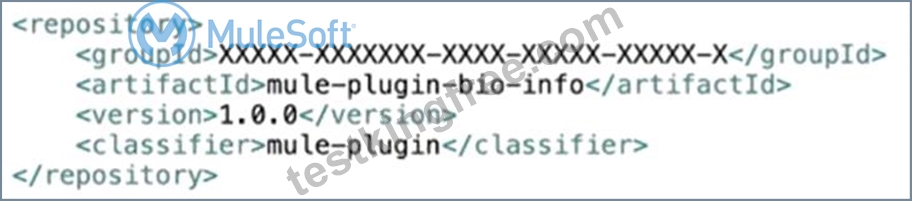
Answer: B
Explanation:
To invoke Bioinfo System API using its REST Connector, option E should be added to the pom.xml file. This option adds a dependency for Bioinfo System API REST Connector with its group ID, artifact ID, version, classifier, and type. The classifier specifies that it is a REST Connector (raml-client), and the type specifies that it is a Mule plugin (mule-plugin).
References:https://docs.mulesoft.com/apikit/4.x/apikit-4-generate-from-rest-api-task#add-the-api-dependency-to
NEW QUESTION # 35
......
New MCD-Level-2 Dumps - Real MuleSoft Exam Questions: https://learningtree.testkingfree.com/MuleSoft/MCD-Level-2-practice-exam-dumps.html