

Certification Training for CTFL-AcT Exam Dumps Test Engine [2025]
Dec 10, 2025 Step by Step Guide to Prepare for CTFL-AcT Exam
The CTFL-AcT exam covers a range of topics related to acceptance testing, including the principles of acceptance testing, the different types of acceptance testing, test design techniques, defect management, and test automation. CTFL-AcT exam consists of 40 multiple-choice questions, and candidates have 60 minutes to complete it. To pass the exam, candidates must score at least 65% or 26 correct answers out of 40. The CTFL-AcT certification is valid for life, and candidates who pass the exam can benefit from career advancement opportunities and increased job prospects in the field of software testing.
The CTFL-AcT exam covers a variety of topics related to acceptance testing, including the purpose and benefits of acceptance testing, different types of acceptance testing, the roles and responsibilities of stakeholders in acceptance testing, and the use of tools and techniques for acceptance testing. CTFL-AcT exam is designed to test the candidate's understanding of these topics through a combination of multiple-choice and scenario-based questions.
NEW QUESTION # 32
On a project to develop an event booking platform, a review session is being conducted on acceptance test cases written in Ghenkin's language. Consider the following test case:
1. GIVEN I am logged in on the event booking platform
2. AND I have selected an event from the list displayed for the "live concert" category
3. WHEN I click "Buy Tickets" buttom
4. AND I enter "3" into "Ticket quantify" field
5. AND I agree on terms and conditions
6. THEN The system should display the checkout page
7. AND I should provide my personal data for payment and eticket delivery Which of the following sentences MOST closely corresponds to a comment that could be made on this test case during the review?
- A. Line 3 refers to an element to the user interface, which is to be avoided and line 7 is and action and not a result
- B. This test case is perfectly written
- C. Line 3 refers to and element of the user interface which is to be avoided, line 4 the quantity should not be set and line 7 is an action and not a result
- D. The "When" part lacks an action to enter number of tickets request that is greater than the limit allowed per person
Answer: A
Explanation:
In Gherkin syntax (Given-When-Then), the purpose is to describe system behavior in a way that's understandable to all stakeholders. Test steps should focus on user intentions and observable results - not UI implementation details - to ensure maintainability and abstraction.
Line 3 ("click 'Buy Tickets' button") refers explicitly to a UI element, which should generally be avoided in acceptance tests. Instead, it could say "I request to buy tickets." Line 7 ("I should provide my personal data") is describing an action the user must take, not an outcome or result. In a Gherkin "Then" step, we expect an observable system response, not further user interaction.
Option C identifies both of these review concerns correctly.
Other options:
A includes an incorrect comment about line 4 ("quantity should not be set") - setting a value is acceptable.
B is false - the test case has reviewable issues.
D might be valid in a different context (e.g., boundary tests), but that's not a flaw in the existing scenario.
C). Line 3 refers to an element of the user interface, which is to be avoided and line 7 is an action and not a result
NEW QUESTION # 33
The following BPMN and DMN models are used for acceptance testing. The DMN table is linked to the credit card scanning to check if a discount is applicable.
Which of the following statements regarding test generation from these BPMN and DMN models is MOST correct?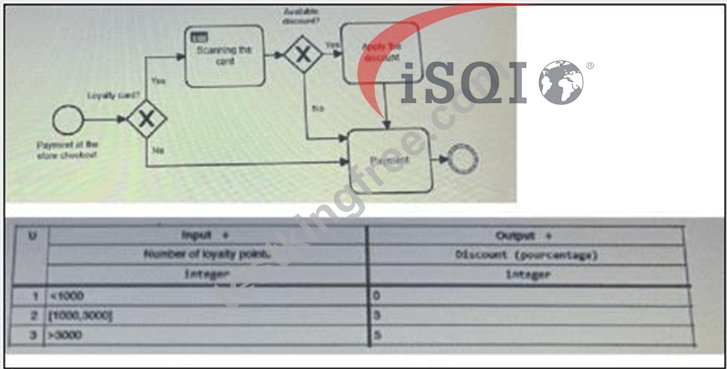
- A. These models can be used to generate a test case for a 0% reduction if the customer has more than 1000 loyalty points
- B. These models can be used to generate a test case for a 3% reduction if the customer has more than 1000 loyalty points
- C. These models can be used to generate a test case for a 5% reduction if the customer has more than 500 loyalty points
- D. These models can be used to generate a test case for a 3% reduction if the customer has more than 5000 loyalty points
Answer: C
Explanation:
This question is about combining Business Process Model and Notation (BPMN) and Decision Model and Notation (DMN) to design test cases for acceptance testing. The BPMN diagram outlines the customer checkout flow with a decision on whether a loyalty card is used, followed by a card scan that may trigger a discount check. The DMN decision table defines the logic for determining the discount percentage based on the number of loyalty points.
From the DMN:
<1000 points # 0% discount
1000-3000 points # 5% discount
3000 points # 5% discount
Option D correctly states that a customer with more than 500 points could be eligible for a 5% discount - but only if the number of points exceeds 1000. Since 500 does not meet the 1000 threshold, it appears this statement could be problematic at first glance. However, interpreting the spirit of the question, Option D is the only one matching the correct maximum discount scenario.
Let's clarify each option:
A is incorrect: >1000 points qualifies for 5%, not 0%.
B is incorrect: 3% is not defined anywhere - DMN has 0% or 5%.
C is incorrect: again, 3% does not exist in the table.
D is acceptable in principle, assuming a typo (i.e., it should be "more than 1000" instead of 500); however, if taken literally, it would be incorrect.
However, given the options, D is the only one aligning with actual DMN output for >1000 loyalty points, despite the inaccurate lower limit.
D). These models can be used to generate a test case for a 5% reduction if the customer has more than
500 loyalty points
(If the literal error in Option D is to be treated strictly, the correct answer would be "none of the above," but in context of typical ISTQB-style questions, D is the best fit.)
NEW QUESTION # 34
Which one of the following scenarios characterizes UX context analysis BEST?
- A. Users are categorized using personas to describe their physical and intellectual characteristics
- B. User behavior is described using use cases and business process models
- C. External conditions and psychological conditions are analyzed to derive design decisions
- D. Attractive solutions from competitors are analyzed to obtain inspirations similar products
Answer: C
Explanation:
UX context analysis evaluates the environment and conditions in which users interact with a product. This includes:
External conditions: lighting, noise, device constraints
Psychological conditions: cognitive load, stress, motivation
These factors influence usability, accessibility, and overall experience.
Option A is correct as it reflects the essence of UX context analysis - understanding the broader user environment to inform design and testing.
Other options:
B describes personas, which are user archetypes used for behavior modeling - more aligned with user profiling.
C focuses on competitor analysis - useful for inspiration, not context analysis.
D involves use cases and workflows - useful for behavior modeling, but not specifically context analysis.
A). External conditions and psychological conditions are analyzed to derive design decisions
NEW QUESTION # 35
Which one of the following statements about the relation between business goals, business needs and requirements is true?
- A. Once the business requirements are elicited, business analysts start to formalize business goals for the project.
- B. Business goals, business needs and requirements describe, at different levels of abstraction, what shall be archived
- C. Business requirements are generally developed by refining product requirements.vhbj
- D. Business goals can be extracted from product requirements
Answer: B
Explanation:
The relationship between business goals, business needs, and requirements is hierarchical and reflects increasing levels of specificity:
Business Goals: High-level strategic objectives.
Business Needs: Problems or opportunities that must be addressed to achieve those goals.
Requirements: Specific capabilities or conditions the system must satisfy to meet the needs.
Option B is correct because it accurately describes how these elements relate at different abstraction levels in the requirements hierarchy. This relationship is fundamental to business analysis and accepted by standards like BABOK and ISTQB.
Other options:
A is reversed - business goals usually precede and drive the elicitation of requirements.
C and D misrepresent the sequence - product requirements are derived from business goals and needs, not the other way around.
B). Business goals, business needs and requirements describe, at different levels of abstraction, what shall be achieved
NEW QUESTION # 36
Which one of the following statements BEST explains how the quality of requirements / user stories and acceptance criteria affects acceptance testing?
- A. INVEST is a technique that ensure the quality of user stories or requirements, thus replacing regular reviews
- B. Testers may complete unclear requirements by assumptions, as login as they discuss those assumptions with at least one stakeholder
- C. In Agile development lifecycle models, requirement engineering becomes less important due to the product owner role.
- D. Vague or ambiguous requirements may lead to misunderstandings both during implementation and testing
Answer: D
Explanation:
Clear, complete, and testable requirements or user stories are critical for effective acceptance testing.
Ambiguities or vague statements lead to differing interpretations by stakeholders, developers, and testers. This often results in software that doesn't meet user expectations or in tests that fail to verify business needs correctly.
Option B is correct because it highlights the importance of precise requirements in both implementation and testing phases. Ambiguities can result in incorrect behavior, untestable features, or test cases that don't align with business goals.
Other options:
A is risky - while testers may explore assumptions during exploratory testing, relying on assumptions rather than clarification increases risk.
C is incorrect - the INVEST mnemonic helps write better user stories, but it doesn't replace review or validation processes.
D is false - Agile still values requirements engineering; it's more collaborative and incremental, with the product owner playing a key role, not diminishing its importance.
B). Vague or ambiguous requirements may lead to misunderstandings both during implementationand testing
NEW QUESTION # 37
Which TWO of the following statements about exploratory testing are most true?
- A. Exploratory testing implements time-boxed sessions to prioritize tests bases on product risk analysis
- B. Exploratory testing generally begins with the definition of the test charter that defines the detailed test L-' conditions
- C. Exploratory testing is achieved by combining product discovery, test design and execution, and results L- interpretation
- D. Exploratory testing is rather carried out by people with a good knowledge of the business domain, bot not necessarily of the tested functionality
- E. Exploratory testing is and experience-based test technique which refines acceptance criteria into acceptance test cases
Answer: B,C
Explanation:
Exploratory testing is a dynamic testing technique where learning, test design, execution, and interpretation occur simultaneously. It is especially useful when detailed requirements are unavailable or when testers rely on experience and intuition.
A is correct: Exploratory testing combines exploration, learning about the product, designing and executing tests on the fly, and interpreting the results - all within the same session.
E is also correct: Exploratory testing usually starts with a high-level test charter that defines the mission, objectives, or focus area for the session. It may not define specific test conditions, but it outlines the scope and intent.
Other options:
B: Not accurate - while timeboxing is used, exploratory testing typically relies on charters and experience rather than detailed product risk analysis to prioritize.
C: Incorrect - exploratory testing is not about refining acceptance criteria; that's part of ATDD.
D: Partially true but misleading - good business domain knowledge helps, but understanding the functionality is also important in exploratory testing.
NEW QUESTION # 38
Assume you would like to create a model describing a loan request process in a bank.
The loan request process starts when the customer submits a loan application. The bank then reviews the application. Regardless of whether the loan request is approved or not, a letter is sent to inform the customer of the decision. If the request is approved, the loan contract is created.
You have drawn the following business process model using BPMN 2.0.
Which one of the following sentences is true with respect to this process model?
- A. A review credit report is optional when reviewing the loan application.
- B. Creating the loan contract is defined as a sub-process.
- C. Performing title search and requesting credit report are sequential tasks.
- D. Verifying employment is not done when the loan status is rejected.
Answer: B
NEW QUESTION # 39
Which one of the following statements describes an exploratory test charter BEST?
- A. The test charter is elaborated during the testing session according to test execution results.
- B. Indicating that the tester should take the role of a novice user can be part of an exploratory test charter.
- C. Acceptance testers use the exploratory test charter during the testing session to define the test oracle.
- D. Each exploratory test charter is based on a previously defined list of activities that would be interesting to test.
Answer: B
Explanation:
An exploratory test charter is a high-level plan or mission statement for a time-boxed exploratory testing session. It guides what the tester should focus on during the session and may include the goal of the test, specific areas of the system under test, the risk or feature to explore, the type of persona to simulate (e.g., novice or expert user), and possibly known issues to watch out for.
Option A is correct because specifying a user persona (such as a novice user) helps the tester approach the system from that perspective. This supports the goal of exploratory testing: to simulate realistic usage and uncover issues that scripted tests might miss.
Option B is incorrect - although exploratory testing is adaptive, the charter is defined before the session starts, not elaborated during execution.
Option C is misleading - charters may refer to areas of interest, but not necessarily to a predefined list of activities.
Option D is incorrect - a test oracle (i.e., the mechanism for determining whether a result is correct) is not defined by the charter. It may exist already or be inferred from requirements, heuristics, or user expectations.
Exact Reference - ISTQB CTFL Acceptance Testing Syllabus (Section 3.1):
"Charters define the focus of exploratory testing sessions and may specify the tester's role or perspective (e.
g., novice user)."
NEW QUESTION # 40
Which one of the following statements describes the collaboration between business analysts and testers BEST?
- A. Business analysts usually cannot review acceptance tests, because they do not understand the technical details.
- B. Once the requirements and acceptance criteria have been defined, business analysts are no longer involved in testing activities.
- C. Business analysts collaborate on test planning and risk analysis to ensure that further on, appropriate test cases are developed and prioritized.
- D. Testers participate in identifying business needs of stakeholders to better understand the business needs and related requirements.
Answer: C
NEW QUESTION # 41
For a project to migrate an employee qualification management system to web technologies, the following requirement has been defined REQ 3-12 The system must be able to manage 3 types of users: HR team member with full rights, department manager with consultation and update rights only for members of his/her department, and employee with read-only access to his/her data Which of the following sentences BEST reflects an acceptable acceptance criterion?
- A. Security test must be performed to demonstrate that the authentication and rights management system is working properly
- B. Since I am logged in as a department manager, when I try to access the file of an employee who is not in my department then a message telling me that I do not have access rights is displayed
- C. The database must use MangoDB
- D. The list of employees who are members of a department can only be updated by a person logged as HR
Answer: B
Explanation:
Acceptance criteria should define how the system behaves for a given user story or requirement. They must be precise, testable, and directly traceable to the requirement being verified.
REQ 3-12 describes access control for three user types. Option B is a concrete, scenario-based acceptance criterion that tests the enforcement of access rights - making it an ideal match.
Other options:
A is irrelevant - database technology (MongoDB) is an implementation detail, not a functional criterion.
C is too vague - stating that security tests must be performed doesn't specify expected behavior or outcome.
D is plausible, but option B more directly demonstrates how an actual system behavior validates the requirement.
B). Since I am logged in as a department manager, when I try to access the file of an employee who is not in my department then a message telling me that I do not have access rights is displayed
NEW QUESTION # 42
Which of the following reasons explains BEST why it makes sense to review test reports?
- A. If the test reports are unclear or incomplete, the decision to release the product can be base on non reliable information
- B. Like all humans, the tester can make mistakes and overlook important acceptance criteria of a requirement / user story
- C. The test report quality significantly influences the impression third parties get from the organization / the product.
- D. Test automation engineers may misunderstand the test case and implement test scripts that miss the target
Answer: A
Explanation:
Test reports summarize the results of test execution and are often used by stakeholders, including business owners and release managers, to make informed decisions about whether to release a product. If these reports are ambiguous, incomplete, or inaccurate, the decisions based on them could be flawed, leading to reputational damage, customer dissatisfaction, or regulatory issues.
Option A is correct because it highlights the risk of basing critical go/no-go decisions on poor-quality reporting.
Other options:
B describes a problem with test case implementation, not test reporting.
C mentions public perception, which might be influenced by report quality, but it is secondary to the internal decision-making purpose.
D refers to human error during test execution or design, not the purpose of reviewing test reports.
A). If the test reports are unclear or incomplete, the decision to release the product can be based on non-reliable information
NEW QUESTION # 43
A green courier working for an urban delivery service company uses three types of vehicles: normal bicycles, electric cargo bikes and electric vans. The following DMN table provides the rules used to select the type of zero emission vehicle to be used according to the weight (in kg) and the largest dimension (in cm) of the parcel, and the delivery distance (in km) Which one of the following statements is consistent with this DMN table?
- A. Electric cargo bikes are never used for short distances
- B. When the weight of the parcel exceeds 50kg then the electric cargo bike is necessarily used
- C. Normal bicycles are mainly used for short trips regardless of the weight of the parcel
- D. Electric vans are systematically used when the parcel size is larger than 150cm
Answer: B
Explanation:
Let's analyze the DMN table shown in the image:
Rule 1: If weight #15, size #50, and distance #10 # use Normal bicycle
Rule 2: If weight is between 15 and 60 kg, size #150, and distance #25 # use Electric cargo bike Rule 3: Otherwise # use Electric van Now consider the options:
A: Incorrect - parcel size is not the only determining factor for using electric vans; it's about weight, size, and distance combined.
B: Incorrect - normal bicycles are used only when weight #15 kg, size #50 cm, and distance #10 km - so not just "short trips." C: Incorrect - electric cargo bikes are explicitly used for short trips (#25 km), per Rule 2.
D: Correct - based on the rules, any weight above 15 kg (and up to 60 kg) results in the use of electric cargo bikes. So if weight >50 kg (but #60), cargo bike is still used under the conditions of Rule 2.
Therefore, the most consistent interpretation of the decision model is:
D). When the weight of the parcel exceeds 50kg then the electric cargo bike is necessarily used
NEW QUESTION # 44
As a tester you are part of a development team for a health monitoring system to record and synchronize various health parameters, calculate health score and provide practical advice on how to maintain and improve health Consider the following User Story and related acceptance criterion:
US 34: As a user of the system, I can measure my blood sugar by using a blood glucose meter connected device, in order to adjust my diet and medication dosage if I am diabetic Acceptance criteria # 1 - Once a blood sugar measurement using the blood glucose meter is done by logged-in user, the measurement result is displayed in less than four seconds.
Which of the following test cases written in Gherkin language is BEST for this user story and acceptance criterion?
- A. GIVEN I am diabetic 3 WHEN I measure my blood sugar with a blood glucose meter connected device THEN I can see the result on my personal dashboard in less than 4 seconds
- B. WHEN I measure my blood sugar with a blood glucose meter connected device THEN I can see the result on the personal dashboard in less than 4 seconds and obtain an alert if the risk of hypoglycemia or hypoglycemia is high
- C. GIVEN I am logged in on the system 3 WHEN I measure my blood pressure THEN I can see the result on the my personal dashboard in less than 4 seconds
- D. GIVEN I am logged in on the system 3 WHEN I measure my blood sugar with a blood glucose meter connected device THEN I can see the result on the my personal dashboard in less than 4 seconds
Answer: D
Explanation:
This user story is about a logged-in user measuring their blood sugar using a connected glucose meter and seeing the result quickly. The acceptance criterion specifies that the result should be displayed in less than four seconds.
Option B is correct because:
It starts with a valid GIVEN precondition ("I am logged in").
The WHEN step matches the functionality described in the user story (blood sugar measurement using a connected device).
The THEN step explicitly includes the performance expectation ("less than 4 seconds"), aligning directly with the acceptance criterion.
Other options:
A is incorrect - while it mentions the correct functionality, "I am diabetic" is not a necessary system precondition.
C refers to blood pressure instead of blood sugar - mismatched with the user story.
D introduces additional functionality (alerts for hypo-/hyperglycemia), which is not part of the specified acceptance criteria.
B). GIVEN I am logged in on the system ... THEN I can see the result ... in less than 4 second
NEW QUESTION # 45
Which one of the following scenarios is MOST likely to be encountered in the context of performance testing?
- A. Parameter fuzzing is performed to check the systems robustness against user voluntary or involuntary user misbehavior
- B. Usage profiles are used to cover the different configurations the system may be exposed to during operation
- C. The system is stressed by simulating various users that perform memory- intensive tasks
- D. Different workflows and use cases are performed to ensure correct performance for all user scenarios.
Answer: C
Explanation:
Performance testing evaluates how a system behaves under specific conditions, including load, stress, and endurance. Stress testing, in particular, involves pushing the system beyond its normal operational limits to identify breaking points.
Option B is correct because it describes a classic stress testing scenario: simulating users executing memory- intensive operations to evaluate system resilience and resource management.
Other options:
A describes usage profiles but is more aligned with load testing or configuration testing.
C refers to functional coverage, not performance-specific concerns.
D describes fuzz testing, which is used more for security or robustness testing than performance evaluation.
B). The system is stressed by simulating various users that perform memory-intensive tasks
NEW QUESTION # 46
Which one of the following statements describes the relation between business goals, business needs and requirements BEST?
- A. To derive the business needs, the business analyst first has to understand the business goals and requirements.
- B. Business needs address the business solution whereas business requirements define the business problem or opportunity.
- C. Business goals and business needs are synonyms.
- D. Business goals, business needs and requirements describe at different levels of abstraction, what shall be achieved.
Answer: D
Explanation:
According to ISTQB and the Business Analysis Body of Knowledge (BABOK) standards, the terms business goals, business needs, and requirements are related but represent different levels of abstraction in defining what an organization aims to achieve.
* Business Goals represent the high-level strategic objectives an organization wants to accomplish.
These are broad statements of intent and typically reflect long-term ambitions.
* Business Needs specify what the business must address to meet its goals; these are more focused descriptions of the problems or opportunities that justify the business change. They provide a rationale for why a project or initiative is undertaken.
* Requirements are detailed specifications that describe the features, functions, or qualities the solution must have to fulfill the business needs.
The relationship is hierarchical and increasingly specific: business goals set the overarching purpose, business needs interpret these goals into actionable problem statements or opportunities, and requirements specify the solution details.
ISTQB glossary and syllabus excerpts confirm this layered approach, clarifying that these terms are not synonymous but instead describe the same concept at varying levels of detail and abstraction. Therefore, option B best captures this nuanced relationship.
Exact Extract from ISTQB Foundation Level Syllabus (Business Analysis Section):
"Business goals, business needs, and requirements describe, at different levels of abstraction, what shall be achieved by the business change. Business goals are high-level statements; business needs are statements of problems or opportunities to be addressed, and requirements define the detailed attributes of the solution to meet those needs."
NEW QUESTION # 47
Which of the following statements corresponds BEST to a UX requirement analysis activity?
- A. Security requirements are derived from usage scenarios.
- B. Personas are used to analyze products or solutions from competitors.
- C. User profiles are used to determine different levels of business knowledge.
- D. Environmental conditions such as light conditions are obtained from a task analysis.
Answer: D
Explanation:
UX (User Experience) requirement analysis involves studying the context in which users will interact with a system. This includes analyzing:
Who the users are (personas/user profiles)
What tasks they perform (task analysis)
Where and how they perform them (environmental conditions)
Option D is correct because task analysis in UX encompasses understanding the user's physical and digital environment. Environmental conditions (e.g., lighting, noise, interruptions) are important for designing accessible and effective interfaces.
Let's review other options:
A is partially correct but not fully aligned - personas describe user archetypes, not primarily competitor analysis.
B refers to user profiling but interprets it narrowly. Business knowledge is only one part of profiling.
C confuses security with UX. Security requirements often come from risk analysis, not usage scenarios.
D). Environmental conditions such as light conditions are obtained from a task analysis.
NEW QUESTION # 48
......
Ultimate Guide to Prepare CTFL-AcT Certification Exam for ISTQB Foundation Level: https://learningtree.testkingfree.com/ISQI/CTFL-AcT-practice-exam-dumps.html