

Pass SAP C-THR81-2405 PDF Dumps | Recently Updated 86 Questions
Updated Test Engine to Practice C-THR81-2405 Dumps & Practice Exam
SAP C-THR81-2405 Exam Syllabus Topics:
| Topic | Details |
|---|---|
| Topic 1 |
|
| Topic 2 |
|
| Topic 3 |
|
| Topic 4 |
|
| Topic 5 |
|
NEW QUESTION # 38
You have updated several position departments using Import and Export data, but the incumbent's data still shows the previous information for the department hris-field.
What are some possible causes for this data inconsistency? Note: There are 2 correct answers to this question.
- A. The business rule to sync data changes sets the Job Information.Department to be equal to Job Information.Position.Department.
- B. The business rule to sync data changes sets the Position Department to be equal to Job Information.Department.
- C. The technicalParameters value has NOT been set to SYNC in the position records.
- D. The technicalParameters column with a value of SYNC has NOT been included in the import file.
Answer: B,D
NEW QUESTION # 39
What tags are supported in alert messages? Note: There are 2 correct answers to this question.
- A. [[EVENT REASON]]
- B. [[HRIS_ELEMENT]]
- C. [[SUBJECT_USER]]
- D. [[RECIPIENT_NAME]]
Answer: A,C
NEW QUESTION # 40
You need to create a one-to-many association from Location to Legal Entity. You also need to configure filtering of the Location field based on the Company field in the Job Information block.
What do you need to add to the data models? Note: There are 2 correct answers to this question.
- A. <field-criteria> as part of <hris-field="location">
- B. <association> as part of <hris-element id="location">
- C. <field-criteria> as part of <hris-field="company">
- D. <association> as part of <hris-element id="jobInfo">
Answer: A,B
Explanation:
To establish a one-to-many association from Location to Legal Entity and enable filtering of the Location field based on the Company field in the Job Information block, the following configurations are necessary:
* Define the Association in the Location Object:
* In thelocationobject definition, add an<association>element to link it to thelegalEntityobject. This association should be defined within the<hris-element id="location">section.
* Configure Field Criteria for the Location Field:
* Within the Job Information (jobInfo) element, add a<field-criteria>element as part of the<hris- field id="location">. This configuration ensures that the Location field is filtered based on the selected Company (Legal Entity) in the Job Information block.
Therefore, the correct answers are:
* B:<field-criteria>as part of<hris-field id="location">
* D:<association>as part of<hris-element id="location">
These configurations align with the standard practices for setting up associations and field criteria in SAP SuccessFactors Employee Central.
NEW QUESTION # 41
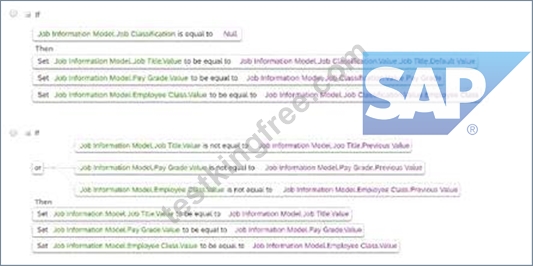
Which rule supports the Default_JobClass requirement?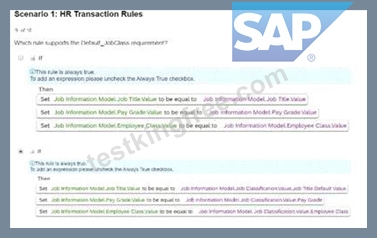
- A. Option A
- B. Option D
- C. Option B
- D. Option C
Answer: C
Explanation:
The rule inOption Bsupports theDefault_JobClassrequirement by setting default values for fields such as Job Title, Pay Grade, and Employee Class when the Job Classification field is NULL. This ensures that appropriate default data is applied to job information records when certain fields are not explicitly filled.
Scenario 1: HR Transaction Rules
NEW QUESTION # 42
How should you build the IF condition to identify the user when the employee is updating their ov Personal Information?
- A.

- B.

- C.

- D.

Answer: A
NEW QUESTION # 43
Which of the following API types does SAP recommend to use to achieve clean core integrations? Note:
There are 2 correct answers to this question.
- A. IDoc
- B. OData
- C. SOAP
- D. RFC
Answer: B,D
NEW QUESTION # 44
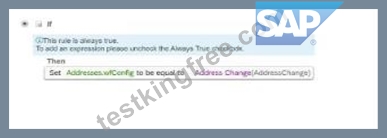
Which clause meets the WFD_Address rule requirement?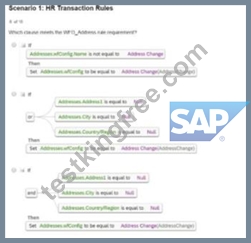
- A. Option A
- B. Option C
- C. Option D
- D. Option B
Answer: C
NEW QUESTION # 45
In which order must you assign the rules?
- A. ERD-Calch, ERD1, ERD2, ERD3, WFD
- B. ERD1, ERD2, ERD3, WFD, ERD-Catch
- C. ERD1, ERD2, ERD3, ERD-Catch, WFD
- D. WFD, ERD1, ERD2, ERD3, ERD-Catch
Answer: C
Explanation:
The rules must be assigned in the orderERD1, ERD2, ERD3, ERD-Catch, WFDfor the following reasons:
* ERD1, ERD2, ERD3: These are specific rules addressing distinct scenarios or conditions in a defined sequence.
* ERD-Catch: Acts as the fallback or catch-all rule to handle any conditions not addressed by the specific ERD rules.
* WFD (Workflow-Driven): This is placed last to ensure workflow-related logic is executed after all event-related data has been validated and processed.
Scenario 1: HR Transaction Rules
NEW QUESTION # 46
Based on the screenshot below, can you identify any errors on the definition of the business rule to Default Position Attributes? Note: There are 2 correct answers to this question.
- A. The workflow configuration should NOT be included in the business rule.
- B. The Parent Position field should NOT be included in the business rule.
- C. The FTE field should be derived from the business rule to Calculate FTE based on Standard Hours.
- D. The Company field should NOT be included in the business rule.
Answer: B,C
Explanation:
* C. The Parent Position field should NOT be included in the business rule:
* The Parent Position field is typically derived automatically based on position hierarchy and does not require explicit inclusion in a business rule for defaulting position attributes.
* D. The FTE field should be derived from the business rule to Calculate FTE based on Standard Hours:
* The FTE (Full-Time Equivalent) value should be calculated using a dedicated rule that accounts for standard hours, rather than being directly included in a defaulting rule.
Including these fields inappropriately can lead to data inconsistencies or rule execution issues.
NEW QUESTION # 47
The employee is changing their marital status. Once the workflow is approved, the manager gets a notification via e-mail that this change has been processed. The manager then goes into the system and checks the workflow, but notices that they can see more fields than the ones for which they should receive a notification (Name, Marital Status, and Nationality). Why is that?
- A. The manager has transactions pending approval permission for Personal Information.
- B. There is a rule that sets up the visibility for the fields in Personal Information and this applies when checking the workflow.
- C. In the workflow, Respect Permissions was set to No for the notification line to the manager.
- D. The manager's approver context is set to Source.
Answer: B
NEW QUESTION # 48
How does the system validate the destination object for composite associations?
- A. The system validates if the destination object has effective dating set to Basic.
- B. The system validates if the destination object has effective dating set to Multiple Changes per Day.
- C. The system validates if the destination object has effective dating set to None.
- D. The system validates if the destination object has effective dating set to From Parent.
Answer: D
NEW QUESTION # 49
How do you create country-specific fields for the Legal Entity object?
- A. As a generic object with a composite association to the Legal Entity object
- B. As an HRIS element in the Corporate Data Model with a composite association to the Legal Entity object
- C. As a generic object with a Valid When association to the Legal Entity object
- D. As an HRIS element in the Country Specific Field for Corporate Data Model with a Valid When association to the Legal Entity object
Answer: A
NEW QUESTION # 50
How do you set the event date in Compensation Information for the JobInfo_FTE_Comp cros rule?
- A.

- B.

- C.

- D.

- E.

- F.

Answer: A
NEW QUESTION # 51
How do you create country/region-specific fields (CSF) for a country that does NOT have pre-delivered Legal Entity CSF fields? Note: There are 3 correct answers to this question.
- A. Create a composite association to the new generic object on Legal Entity.
- B. Update the field criteria of the association.
- C. Update the condition and condition values of the association.
- D. Create a new generic object.
- E. Create a composite association on the new generic object to Legal Entity.
Answer: B,D,E
NEW QUESTION # 52
An employee will be changing their nationality information on their own How do you build the IF condition in the business rule so they can do this?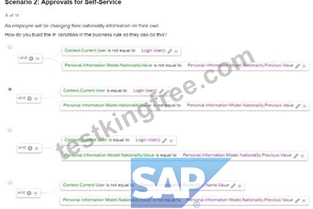
- A. Option A
- B. Option D
- C. Option B
- D. Option C
Answer: C
Explanation:
In order for an employee to change their nationality information on their own, theIF conditionmust:
* Validate that theContext.Current Useris equal toLogin User(ensures that the logged-in user is making the changes).
* Check if theNationality.Valueis not equal to theNationality.Previous Value(ensures that a change is being made).
Scenario 2: Approvals for Self-Service
NEW QUESTION # 53
What does SAP SuccessFactors recommend when you create custom associations between foundation objects (FO)?
- A. All custom associations should be built as one-to-one.
- B. All custom associations should be built as one-to-many.
- C. All custom associations should be built between an XML FO and another XML FO.
- D. All custom associations should be built between an MDF FO and another MDF FO.
Answer: B
Explanation:
SAP SuccessFactors recommends that all custom associations between foundation objects (FO) be built as one-to-many. This configuration reflects real-world organizational structures where a single entity, such as a department, can be associated with multiple positions or employees. Implementing one-to-many associations ensures flexibility and scalability in the system, allowing for accurate representation of complex organizational relationships.
NEW QUESTION # 54
......
SAP C-THR81-2405 Dumps Cover Real Exam Questions: https://learningtree.testkingfree.com/SAP/C-THR81-2405-practice-exam-dumps.html